
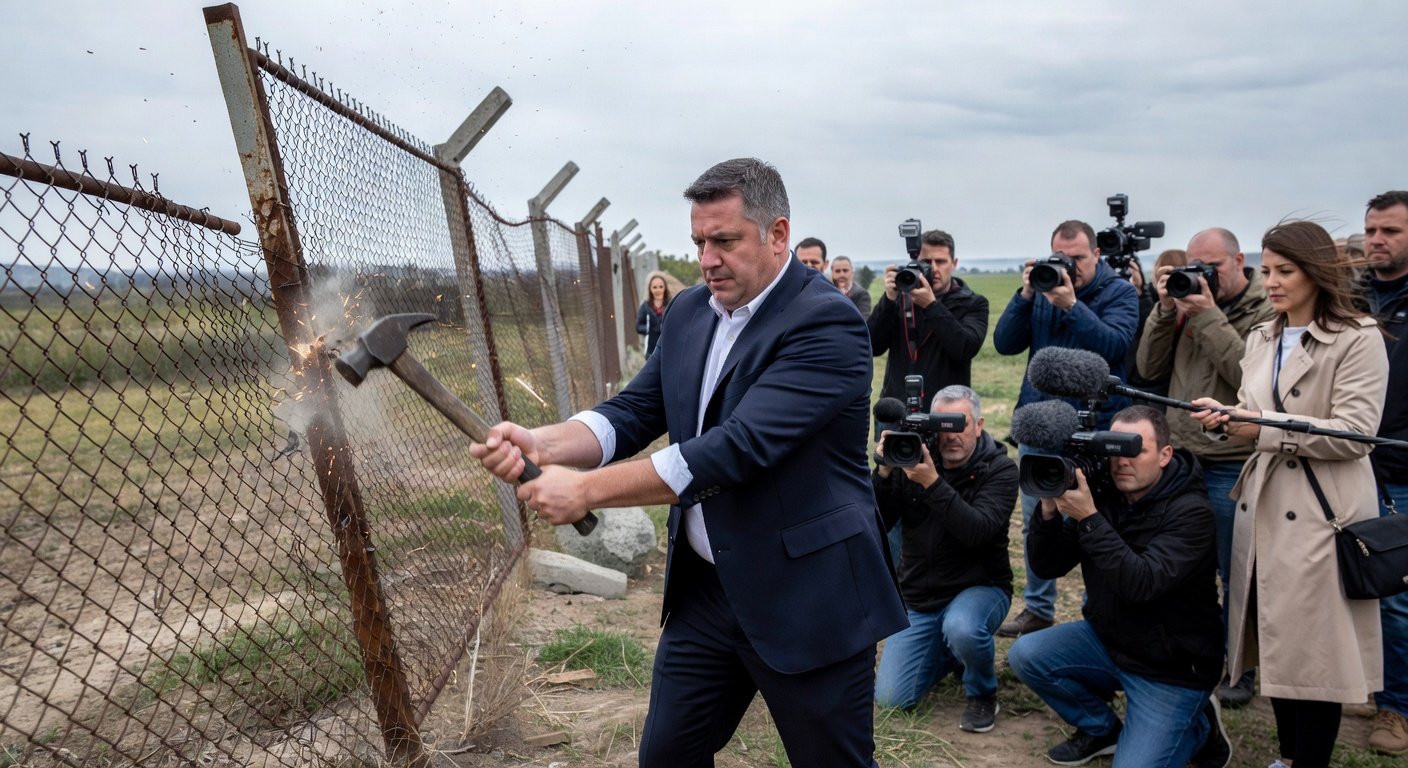
Physical Barriers Fall, Symbolic Walls Crack
Hungary’s new Prime Minister, Péter Magyar, wasted no time making a statement, personally tearing down the fences that had encircled the historic Karmelita Palace in Budapest. This wasn’t merely landscaping; it was a blunt declaration against his predecessor, Viktor Orbán, whose 16-year tenure defined the building as an autocratic stronghold. On Friday, May 15, 2026, Magyar, flanked by ministers, pushed open the barriers, signaling a “change of regime” and an end to an era where public access to public institutions was, apparently, optional. The immediate gesture suggests a new administration less keen on architectural cordons and more focused on public optics.
The Karmelita, a former Catholic monastery perched on Budapest’s landmark Castle Hill, became a flashpoint under Orbán, cordoned off in 2021. Its isolation turned it into a stark symbol of his government’s perceived detachment from the populace. Magyar made it clear the famous building, funded by Hungarian taxpayers, should be accessible. “There is no place for cordons in Hungary after the change of regime,” he stated, cutting straight to the point. This symbolic act aims to dismantle not just physical barriers but also the ideological ones that characterized Orbán’s rule, re-establishing a public connection to national heritage and resources.
Mandate for Change: Rebuilding Democratic Institutions
Magyar’s ascent to power, leading the center-right Tisza party, was decisive. He swept Orbán’s Fidesz party from its dominant position in April, securing a two-thirds majority and a clear mandate for significant systemic overhauls. This victory ended Orbán’s prolonged grip on power, a period marked by allegations of democratic backsliding and institutional erosion. His campaign tapped into widespread public fatigue with the established order, promising a fresh approach. The electorate, clearly seeking change after 16 years, bought into Magyar’s vision of a more transparent and accountable government, ready to dismantle the old guard’s structures.
Central to Magyar’s reform agenda is the commitment to genuinely restore democratic institutions and governmental checks and balances. These mechanisms, proponents argue, were systematically weakened during Orbán’s lengthy rule, consolidating power in the executive. Magyar aims to reverse this trend by strengthening parliamentary oversight, ensuring judicial independence, and fostering a free press. His rhetoric suggests a return to a more robust separation of powers, crucial for preventing future authoritarian drift. This involves more than just symbolic gestures; it requires legislative action and a fundamental shift in political culture to be truly effective.
Corruption allegations were central to Magyar’s campaign, resonating with a public tired of perceived financial misconduct. He openly criticized the lavish renovations undertaken by former government officials in their offices, implicitly contrasting them with his promised austerity. Magyar himself plans to relocate his office from the Karmelita to the administrative district on the Danube’s opposite bank, refusing to inhabit the gilded cage. To address past financial improprieties head-on, he intends to establish a National Asset Recovery and Protection Office. This authority will be tasked specifically with investigating and retrieving public funds allegedly misused during Orbán’s tenure, signaling a zero-tolerance approach to past indiscretions.
Realigning Foreign Policy and Future Prospects
Beyond domestic reforms, Magyar aims to recalibrate Hungary’s international standing. His administration has promised to mend strained relationships with European Union partners, a crucial move given Orbán’s often confrontational stance with Brussels. The objective is to reaffirm Hungary’s role and reputation among Western democracies, signaling a departure from the more isolationist tendencies of the past. This re-engagement seeks to rebuild trust and facilitate stronger alliances, which will likely involve a more cooperative approach to shared European challenges, rather than persistent discord, and a clear move away from past antagonisms.
The Karmelita building itself, now liberated from its protective barriers, faces an undefined future, though public access is guaranteed for an “extensive period.” A dedicated website already facilitates visitor tours, indicating an immediate shift towards transparency and public engagement. While some castle zone buildings have seen renovation, others remain under construction, hinting at broader urban development initiatives. Magyar noted the situation “is likely to generate a number of new ideas,” a suitably vague statement that could mean anything from museum conversions to public event spaces. The next step is clearly demonstrating tangible progress on his reform promises, beyond the initial symbolism.
Quick Facts
- •💡 New Hungarian PM Péter Magyar personally removed fences around the Karmelita Palace.
- •💡 Former PM Viktor Orbán had cordoned off the Karmelita Palace in 2021.
- •💡 Magyar’s center-right Tisza party won a two-thirds majority in the April election.
- •💡 The Karmelita Palace served as Orbán’s office during his 16 years in power.
- •💡 Magyar plans to form a National Asset Recovery and Protection Office to investigate misused public funds.