
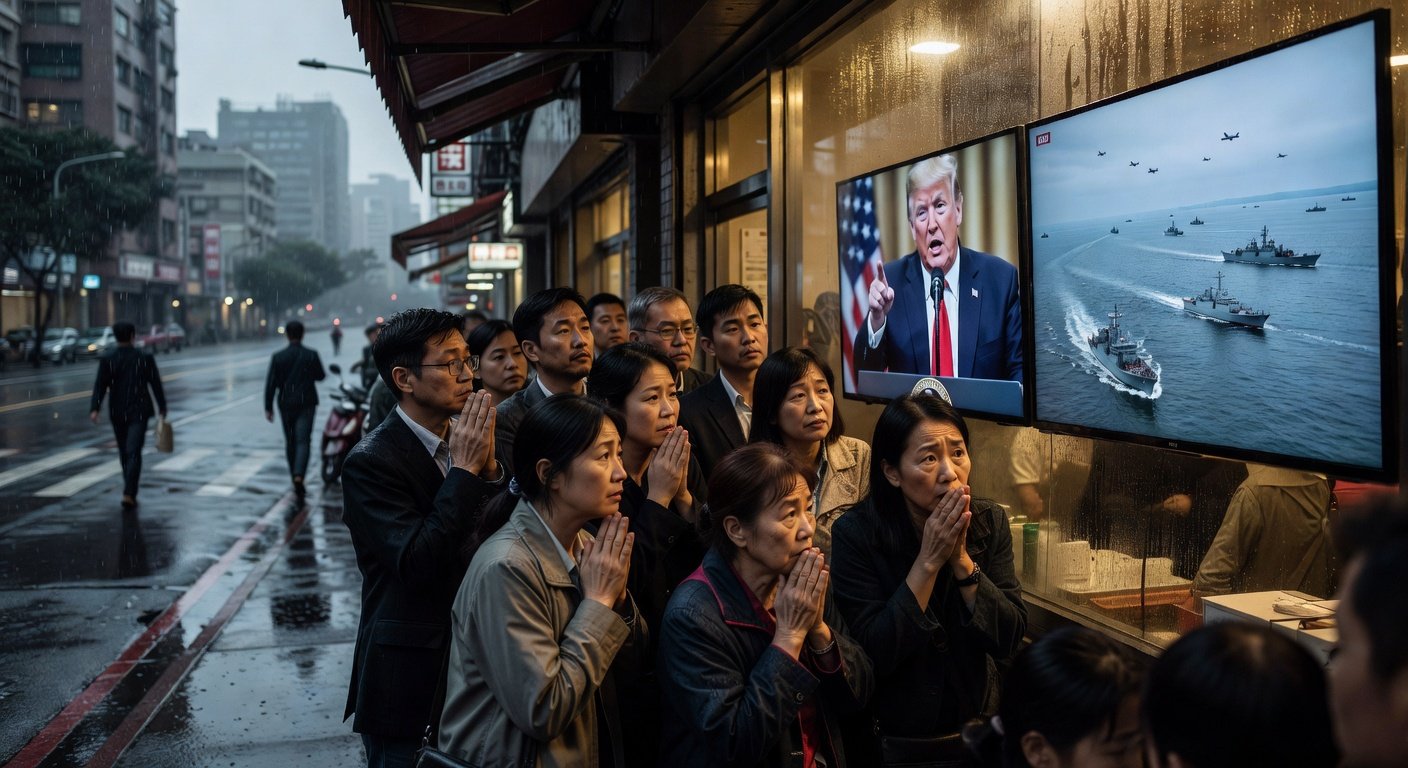
Taiwan as a Bargaining Chip
U.S. President Donald Trump, fresh off a China visit, declared in a Fox News interview that American arms sales to Taiwan are a “very good negotiating chip.” This blunt assessment immediately ratcheted up anxiety levels on the self-governing island Beijing claims as its own. Trump specifically held up a pending $14 billion arms package, stating its approval now “depends on China.” His rationale? “It’s a lot of weapons,” and thus, valuable leverage.
Taiwanese officials and analysts interpret this as a potential “nightmare scenario.” For decades, the U.S. has been Taiwan’s staunch, albeit unofficial, ally and primary arms supplier, legally bound to provide defense capabilities. Beijing, viewing Taiwan as a breakaway province, hasn’t ruled out force for reunification. Trump’s suggestion of conditioning defense support on unrelated negotiations with China places Taiwan squarely on the chopping block, rather than at the table, as William Yang, a Northeast Asia analyst, starkly put it.
Chipmaking Demands and Beijing’s Warnings
Beyond defense, Trump also pushed for a seismic shift in the global microchip industry, urging Taiwan’s dominant chipmakers to relocate production to the U.S. Taiwan produces over 90% of the world’s most advanced chips, critical for AI, smartphones, and military applications. While the island’s leading manufacturer, TSMC, has committed $165 billion to a mega-campus in Arizona, and Taiwan pledged a total of $250 billion in U.S. microchip investment this year, Trump reiterated past accusations that Taiwan “stole” its chipmaking sector from the U.S. decades ago. It seems gratitude has a short shelf life.
China, meanwhile, has made its position unequivocally clear. Chinese President Xi Jinping recently branded Taiwan “the most important issue” in U.S.-China relations, following up with a warning to Trump of potential “clashes and even conflicts” if the matter isn’t handled “properly.” This isn’t mere rhetoric; Beijing reacted furiously to a separate $11 billion U.S. arms package approved earlier, staging live-fire drills around Taiwan. Despite this, Taiwan’s presidential office, through spokesperson Karen Kuo, maintained that consistent U.S. policy remains unchanged, reaffirming Taiwan as a “sovereign, independent, democratic country” and stressing the legality of U.S. arms sales.
Narrative Alignment and Uncertain Futures
Troublingly, Trump appears to be adopting elements of Beijing’s narrative regarding Taiwan’s current leadership. While he didn’t explicitly alter U.S. policy wording, a move many observers feared, he stated, “They have somebody there now that wants to go independent,” likely referring to Taiwanese President Lai Ching-te. Beijing has labeled Lai a “Taiwan independence diehard,” accusing him of risking war. Trump echoed this, implying Taiwan’s pursuit of independence is driven by a desire for conflict, with the U.S. expected to foot the bill. He further asserted his disinterest in fighting a war “thousands of miles away.”
This shift in rhetoric aligns with China’s long-standing attempts to isolate Taiwan and discredit its democratic leadership. While U.S. officials typically avoid direct communication with Taiwanese leaders, past administrations permitted transit stops for figures like former President Tsai Ing-wen. Lai, however, has yet to step foot on the U.S. mainland during his nearly two-year presidency, a move some interpret as a rollback of U.S. support. It’s a calculated ambiguity, leaving Taiwan to wonder if its strongest supporter is now its weakest link.
Wen-Ti Sung of the Atlantic Council views Trump’s statements as his “transactional rhetoric being turned up to the max.” The real concern isn’t just the words, but the potential substance behind them. Taiwan remains in a holding pattern, hoping U.S. statutory commitments outweigh the shifting sands of political negotiation. For Taiwan, the question isn’t if the U.S. will support its defense, but at what price, and whose expense.
Quick Facts
- •💡 Donald Trump stated U.S. arms sales to Taiwan are a “very good negotiating chip” with China.
- •💡 He confirmed a $14 billion arms package for Taiwan is “in abeyance” and ‘depends on China.’
- •💡 China regards Taiwan as a breakaway province, ready for reunification by force if necessary.
- •💡 Trump called for Taiwan’s chipmakers, producing over 90% of advanced chips, to move to the U.S.
- •💡 Chinese President Xi Jinping warned of “clashes and even conflicts” over Taiwan if not handled properly.