
Retreat from Chaos
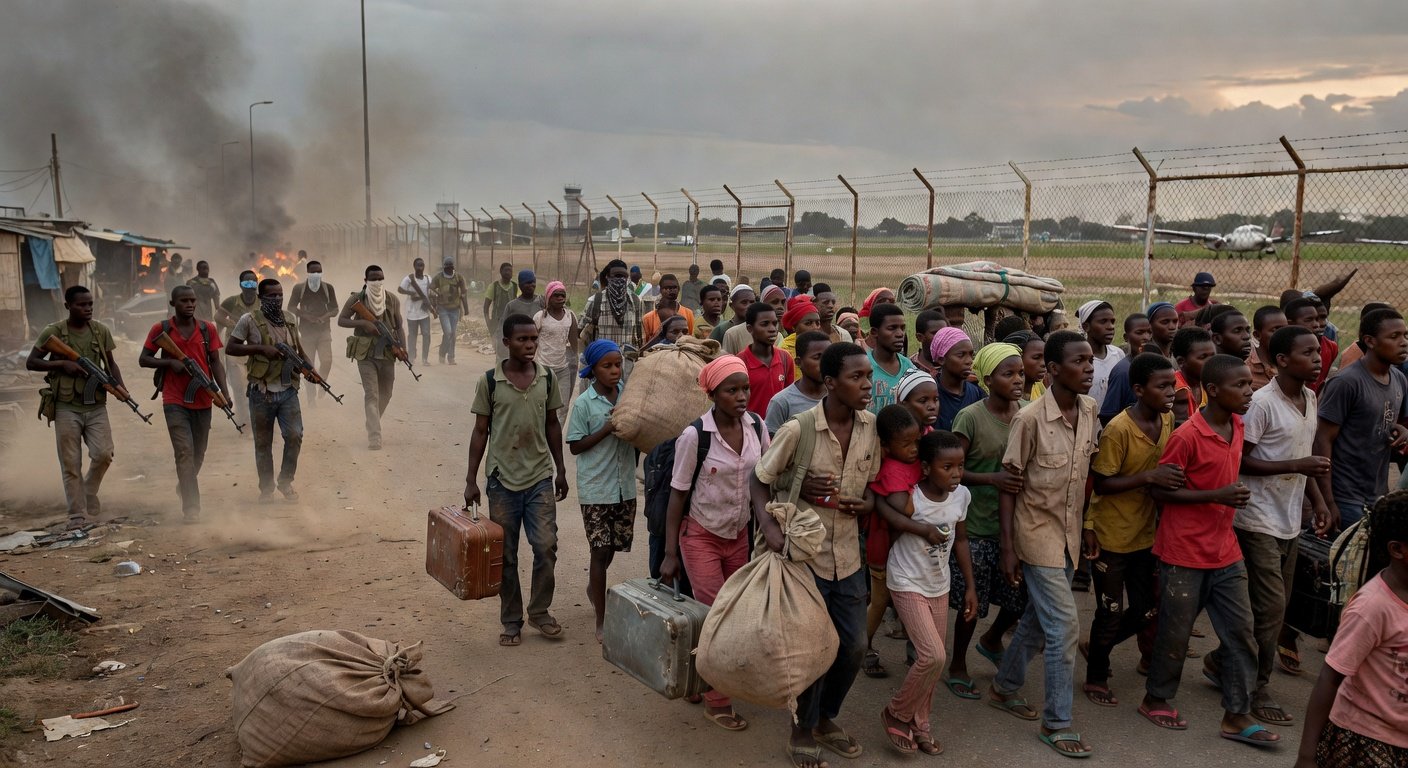
Hundreds fled their homes over the weekend in Port-au-Prince, Haiti, seeking refuge along the main airport road by Monday, May 11, 2026. This latest exodus stems from intensifying gang violence, which has seen armed groups torching houses in residential areas. Monique Verdieux, 56, recounted watching her neighborhood burn, her family scattered, and now she sleeps on the street. Such scenes are routine in a capital where gangs assert control over more than 90% of the city, a grim reality cemented since the assassination of President Jovenal Moïse in July 2021.
The humanitarian toll is immediate and severe. Doctors Without Borders (MSF) evacuated its Cité Soleil hospital on Sunday after intense clashes, reporting over 40 gunshot victims treated within a mere 12 hours. The organization also provided temporary shelter to 800 civilians fleeing the relentless violence, even as a security guard was hit by a stray bullet on hospital grounds. “Unthinkable that our teams and civilians should become victims,” stated Davina Hayles, MSF’s head of mission. Apparently, even medical neutrality is now a casualty of gangland ambition.
Crippling Infrastructure & Economic Strain
Beyond the capital’s immediate environs, gang activities now plague the countryside, expanding their repertoire to include looting, kidnapping, sexual assaults, and rape. Haiti, devoid of a president since 2021, offers little in the way of cohesive resistance. This vacuum allows criminality to metastasize, dismantling what little stability remains. The notion of a functional state diminishes with each reported atrocity, leaving citizens to contend with an escalating, unchecked reign of terror that permeates daily life.
The escalating insecurity has choked vital economic arteries. Haitian rum maker Barbancourt and two major bottlers recently warned that conditions near Toussaint Louverture International Airport have severely restricted operations. Their joint statement bluntly described the government’s response as “largely insufficient,” pointing out that degraded roads around the airport impede security forces. It seems securing an airport is rather difficult when the routes to it are effectively warzones. These companies, it’s worth noting, represent significant fiscal contributors to an already strained national treasury.
International Response & Persistent Displacement
A glimmer, however faint, of international intervention arrived in April with the first foreign troops connected to a U.N. force. The U.N. Security Council authorized a 5,550-member force last September, yet its full deployment remains elusive, with only an unspecified number of troops from Chad having arrived so far. A piecemeal approach, perhaps, to a problem requiring full commitment. One might wonder if the gangs received an advanced copy of the deployment schedule.
Meanwhile, the human cost continues to mount. A recent report by the International Organization for Migration (IOM) confirms that gang violence has displaced over 1.4 million people across Haiti. Roughly 200,000 of these now endure crowded, underfunded conditions within the capital itself. The “what happens next” is clear: more displacement, continued suffering, and an international community slowly, perhaps too slowly, assembling the tools to address a crisis that has long passed the point of mere urgency.
Quick Facts
- •💡 New gang violence displaced hundreds near Port-au-Prince’s main airport on May 11, 2026.
- •💡 Gangs control over 90% of Port-au-Prince since President Moïse’s 2021 assassination.
- •💡 Doctors Without Borders evacuated a hospital, treating over 40 gunshot victims and sheltering 800 people.
- •💡 Major Haitian businesses report airport operations severely restricted due to insecurity, blaming “insufficient” government response.
- •💡 Over 1.4 million people in Haiti are displaced by gang violence, with a partial UN force now deployed to quell it.